
Improving Guaranteed Income with Living Benefits

MMSD Thought Leadership

Built for Creating Opportunities

Wade Pfau Headshot

By Wade D. Pfau, Ph. D., CFA, RICP

Professor of Practice at The American College of Financial Services

Comparing Guaranteed Lifetime Withdrawal Benefit Riders within Variable Annuities

Executive Summary

More Americans are interested in generating guaranteed income in retirement. In fact, LIMRA research shows there has been an increase in workers’ willingness to convert assets into lifetime-guaranteed income, which has increased 14 percentage points from 38% in 2017 to 52% in 2023.1 Variable annuities, when annuitized, are one solution available to generate guaranteed income. Variable annuities may also offer an income rider, such as a guaranteed lifetime withdrawal benefit (GLWB), which offers guaranteed income for the lifetime of the contract holder for an additional cost without the loss of control over the annuity contract value that occurs when an annuity contract is annuitized. Annuitization is an irreversible commitment to converting an annuity contract into a series of payments, and GLWBs provide a method for constructing guaranteed lifetime withdrawal amounts while maintaining flexibility to end the payments.

This paper analyzes the hypothetical historical performance of MassMutual EnvisionSM variable annuity with a GLWB called MassMutual RetirePaySM, compared to different variable annuities with a GLWB. Not all GLWB riders are the same. Some focus on growth of the benefit base, while others place an emphasis on the withdrawal rates.

The purpose of this analysis is to help financial professionals compare the benefits and constraints of the most popular designs of GLWBs to see which provide clients with the highest level of income. The variable annuities with GLWBs in this paper are based off the top-selling products in the marketplace today. Historical time periods, both bull and bear markets, were used to determine which GLWB structure would have provided the contract holder with the highest annual guaranteed income amount at different issue ages and deferral periods. This guaranteed lifetime income is key for determining which product is the best fit for clients.

Overall, the analysis suggests that RetirePay provides the most guaranteed annual lifetime income in many scenarios due to the higher withdrawal rate. It is important to note that RetirePay and traditional GLWB riders are retirement income solutions that fit different client needs and scenarios. Traditional GLWBs offer benefit base guaranteed growth using roll-ups. This might be best for someone who values guarantees or wants to plan with a guaranteed growth model, because the annual minimum increase to the benefit base is known regardless of market conditions. RetirePay takes a different approach by using a withdrawal rate that increases with the length of deferral, which creates a similar impact as a roll-up, offering the potential for higher lifetime income in longer deferral periods or in periods with strong market performance.

MassMutual has designed their GLWB to focus on the growth of the withdrawal rates compared to concentrating on the benefit base growth like most traditional GLWB designs. In instances where a client can wait 10 or more years, they enjoy a higher withdrawal rate for up to 10 years and they have more opportunity for market growth, which could result in a higher benefit base. These are both ways to support more guaranteed income for clients.

Introduction

Americans are living longer than previous generations, sparking the fear of outliving savings as many are without a pension plan to help cover the income gap left by Social Security during retirement. Many economists believe annuities can help retirees solve this problem, yet consumers are still not utilizing annuities for a guaranteed income stream as they do not want to give up access to their funds to create their own pension-like income. This is known as the annuity puzzle.

The key to solving the annuity puzzle is to help retirees understand the benefits of a variable annuity with an income (GLWB) rider. Variable annuities with GLWBs are retirement income tools, providing behavioral solutions to help solve the annuity puzzle — which focuses on how individuals are generally less comfortable not having access to their contract value and not wanting to give up investing upside potential. Variable annuities allow contract holders the ability to invest their purchase payments into various sub-account options across multiple asset classes. This allows clients to continue to invest their money in the market while having a solution to provide lifetime income to help solve their income gap in retirement.

Variable annuities are complex products that can be used to help generate guaranteed income streams for clients through an optional guaranteed lifetime withdrawal benefit rider for an additional cost. A GLWB’s appeal to retirees is its ability to provide downside protection to the benefit base with a guaranteed stream of lifetime income, upside growth potential through its underlying sub-account choices, and a certain level of liquidity, while also offering the potential for tax deferral when compared with currently taxable investments. Tax deferral is automatically provided by tax-qualified retirement plans including IRAs. There is no additional tax deferral provided when a variable annuity contract is used to fund a tax-qualified retirement plan including IRAs.

Retirees have access to their account value; they can remain invested in the annuity sub-accounts, and any assets remaining at death are available to beneficiaries as a death benefit. Retirees also have the ability to liquidate part or all of their money in case of an emergency.

Risk pooling through an optional GLWB rider for a variable annuity can be a more effective way to manage longevity and market risks because it allows retirees to spend their savings as though they will experience average outcomes, even though the majority of retirees are above or below the average. Risk pooling for longevity risk is not a new concept but is at the core of all income annuities. Those with average lengths of life and average market returns, who do not end up outliving their assets, will have paid an insurance premium (i.e., the GLWB rider fee) that is used to support spending for those who experience a longer retirement combined with poor market returns that leads them to outlive the annuity contract value. This can allow everyone in the risk pool to spend more than they may otherwise feel comfortable spending without a guarantee in place.

The question retirees face is how to determine which annuity with a GLWB will support the most retirement spending potential across the range of potential outcomes that link to realized market returns. This can be a complicated matter, as it involves the interaction of many GLWB factors: roll-ups and step-ups for the benefit base, asset allocation rules, age-based guaranteed withdrawal rates, and annuity fees. It is the interaction of these factors that work to generate guaranteed lifetime income.

Many consumers tend to focus on one salient characteristic, such as which variable annuity living benefit offers the highest roll-up rate, forgetting the second half of the guaranteed withdrawal benefit calculation, which is the lifetime withdrawal percentage. This limited focus can be to the detriment of the consumer if a high roll-up rate is combined with other characteristics, such as lower withdrawal rates and higher fees, that lead to less overall guaranteed income. One should focus on the main goal, which is to determine what solution can provide the highest annual guaranteed income for a client to help combat the risk of outliving their savings in retirement.

Accumulation Period

For deferred variable annuities with GLWBs, we begin with the growth process for the benefit base during the accumulation period before guaranteed withdrawals begin. This accumulation period is relevant not for retirees seeking to take “income now,” but rather “income soon” or “income later” because with “income now,” the accumulation period is skipped, and the benefit base does not grow before withdrawals begin. For the “income soon” and “income later” groups, it is the interaction of what happens in the accumulation period and the withdrawal benefit period that impacts their experience. This growth is important because it may subsequently be used to determine the amount of guaranteed lifetime income the client will receive.

Deferred variable annuities with GLWB riders may provide a guaranteed growth rate on the benefit base during the accumulation period before guaranteed income distributions begin. GLWB riders also may define the benefit base as the high watermark of the contract value on contract anniversary dates, or more frequently. The benefit base is a number used to calculate the amount of guaranteed income paid during the withdrawal phase. It is distinct from the contract value, which is what the owner could access based on actual account growth net of fees and any surrender charges. Contract owners cannot withdraw or annuitize the benefit base value; this is solely for determining the annual income amount during the withdrawal period.

Generally, the benefit base can grow at the higher of either a guaranteed roll-up rate or the high watermark achieved through investment growth of the contract value of the annuity (step-ups). Their interaction can get confusing, as roll-ups and step-ups are not interchangeable terms. Roll-ups are a guaranteed minimum growth rate for the benefit base or a guaranteed minimum growth rate of withdrawal percentage, and step-ups are increases for the benefit base, which are triggered when the contract value has grown to exceed the existing benefit base on a determined date due to positive market performance or additional purchase payments. A roll-up is not exclusive to the benefit base, as some products allow for the guaranteed annual withdrawal rate to roll-up from an annual increase to the withdrawal percentage for each additional year the contract owner waits to exercise GLWB withdrawals.

We can consider a benefit base roll-up rate that is applied annually on the contract anniversary date. If a GLWB offers a 5% guaranteed compounded roll-up rate during the accumulation period, then the benefit base supported by a $100,000 purchase payment would grow to $127,628 after five years (100,000 x 1.05 for 5 years) and to $162,890 after 10 years (100,000 x 1.05 for 10 years) assuming no excess withdrawals. If this were instead a 5% simple growth rate, then 5% of the initial purchase payment would be added to the benefit base after each year, leading to $125,000 after five years and $150,000 after 10 years. Longer deferral periods prior to withdrawals provide more opportunity for a compounded roll-up rate to move ahead with growth on past growth as well.

The guaranteed benefit base roll-up rate is not a guaranteed investment return. It does not apply to the contract value. It only applies to the benefit base used to calculate guaranteed income amounts. This detail is a constant source of confusion for individuals and is one of the reasons why some insurance carriers have moved the focus to the guaranteed withdrawal percentage.

Another reason that the benefit base can increase is because the contract value has grown to achieve a new high watermark that exceeds the value of the benefit base, including any roll-ups due to positive market performance. This is referred to as a step-up. Most commonly, these step-ups are applied for contract value growth on an annual basis at the contract anniversary date. If the contract value is greater than the benefit base on the contract anniversary date, then the benefit base is adjusted upward to match the contract value at this time. In these cases, if the contract value reached a new high watermark earlier in the year but then dropped by the anniversary date, the higher earlier value would not matter. Only the value on the designated dates is used to determine if a new high watermark has been achieved.

As with roll-ups, the ability to apply step-ups on a more frequent basis, such as daily, monthly, or quarterly, may be valuable to the annuity holder. It creates more opportunities for growth in the contract value to achieve new high watermarks for the benefit base. Many annuities offer multiple options to the purchaser, with more frequent step-up opportunities being accompanied by a higher fee.

A final consideration for deferrals is how the benefit base roll-up rate reacts to step-ups of the benefit base. There are two basic options: 1) the benefit base roll-up might only be applied to the original purchase payment, or 2) the benefit base roll-up rate may stack on top of step-ups achieved through contract growth. With stacking, if a step-up is achieved, the roll-up rate begins to be applied to this new benefit base, rather than only being applied to the original purchase payment. This allows for greater subsequent growth of the benefit base at the roll-up rate from that new high watermark.

Without stacking, roll-ups continue to be applied to the original purchase payment and must play catch-up to the step-up for roll-ups to again have an impact.

Withdrawal Benefit Period

The withdrawal benefit period begins once guaranteed lifetime distributions commence. The age at which this occurs is what we call the income start age. Guaranteed income will be set using an age-based guaranteed withdrawal percentage rate applied to the value of the benefit base. The guaranteed withdrawal rate multiplied by the benefit base sets a guaranteed distribution amount provided for life, even if the contract value of the underlying assets is depleted, assuming no excess withdrawals are taken. Guaranteed distributions may even increase through step-ups if new high watermarks are reached for the underlying contract value on the designated anniversary dates, although step-ups will be more difficult to achieve as the contract value is depleted by the guaranteed distributions.

These guaranteed withdrawal rates are typically based on the age that lifetime guaranteed distributions begin, and on whether the distribution is taken by a single individual or by a couple. These withdrawal rates can vary between companies and even for different versions of GLWBs offered by the same company. Some withdrawal rates grow during the accumulation period and are based on the number of years deferred before taking withdrawals. Therefore, annuity holders are rewarded for waiting longer before starting income. This allows for different withdrawal rates at the same age, which differ based on the length of the accumulation period. The age-based withdrawal rate schedule is set at the time of the contract issuance and will not change for that contract holder, though over time the rates may change for new purchasers.

When considering a GLWB, it is important to consider the joint impact of both the benefit base roll-up rates and the withdrawal rates on the amount of guaranteed income the annuity supports. A retiree must understand this relationship and not solely focus on the benefit base roll-up alone, as this is only part of the equation for their guaranteed income stream.

It may not be immediately obvious to someone whether an annuity with a 5% compounded benefit base roll-up rate and a 5% withdrawal rate is better than an annuity with a 4% compounded benefit base roll-up rate and a 6% withdrawal rate. The answer also depends on how long the deferral period lasts before income begins, as longer deferral periods will increase the relative importance of the roll-up rate, and shorter deferral periods mean one should instead focus more on the withdrawal rate.

The answers may be surprising. For instance, consider someone placing a $100,000 purchase payment into a variable annuity with a GLWB and deferring for 10 years before distributions begin. If no step-ups take place, and assuming no withdrawals are taken prior to beginning guaranteed income, a 4% roll-up and 6% withdrawal rate provides $8,861 of guaranteed annual lifetime income, which is quite a bit more than the $8,144 provided by the 5% roll-up and 5% withdrawal combination. The former provides more guaranteed income, which is the whole point of a lifetime income guarantee. It is important to focus on the guaranteed income provided by the roll-up and withdrawal factors, rather than trying to make some determination in isolation about which combination of factors sounds better. On top of this, one must also consider the likelihood for step-ups to further increase these guaranteed income levels.

Fees and Asset Allocation

Fees and investment opportunities matter in determining upside potential for the contract value and whether step-ups are achieved. Greater risk exposure can increase the possibility for reaching new high watermarks net of fees and distributions, which can increase the benefit base and level of guaranteed income. Higher fees, meanwhile, would create more drag on returns, reducing opportunities for step-ups to the benefit base.

The ability to invest more aggressively is a clear advantage provided to the retiree by an income guarantee, and this is a risk that must be managed by the insurance company offering the guarantee. Investing aggressively creates more upside potential for the retiree. Investment growth that leads to step-ups means both a larger benefit base and a larger contract value. Retirees then only experience a portion of the downside risk because market losses will reduce the contract value, but the income guarantee will support lifetime spending even if the underlying assets deplete through a combination of portfolio losses and distributions, subject to no excess withdrawals.

The income guarantee behaves as a type of “put option” on the stock market, as it supports upside growth while reducing the potential harm to the lifetime standard of living resulting from market losses.

Two key methods insurance companies use to control this exposure to market volatility and losses are to limit the total allocation allowed to risky assets, or to raise the fees for income protection so that more funds are available for hedging this risk.

As for investment constraints, the simplest is to create a maximum allowed allocation to risky investments such as equities. Annuity holders may have investment freedom for choosing among the funds within the annuity, but they would be restricted from increasing the overall risky allocation above some limit, such as 70% or 80%.

The assumptions made about asset allocation for an annuity versus unguaranteed investment funds are incredibly important. It is natural that retirees with income guarantees may feel more comfortable accepting a more aggressive asset allocation, and ideally one should compare approaches using the asset allocations a retiree would choose for both a guaranteed and unguaranteed approach. This will be individual specific. Research based on over one million variable annuity contract holders shows that those with optional income guarantees were willing to have about a 5% to 30% higher equity allocation than those without guarantees on their variable annuities.2 For instance, someone willing to hold 40% equities without a guarantee may increase their equity allocation to between 45% and 70% (if allowed) with an income guarantee in place.

Alternatively, fees can be used to purchase financial derivatives and support other forms of risk management for the guarantee. Deferred variable annuities generally have several types of ongoing fees. The first relates to the underlying funds expenses that would be included with any mutual fund investment.

The second type of fee relates to mortality and expense charges or other administrative charges for the insurance company. These fees help to support the risk pooling and business costs of the insurance company as well as basic annuity death benefits. These fees are also generally charged on the contract value. The mortality and expense charge protects insurance companies against unexpected events, including the untimely death of the policyholder.

Finally, optional riders providing living benefits through a GLWB assess an additional ongoing charge. The rider fee is charged while contract value remains. Rider charges end after the contract value is depleted and the contract enters its settlement phase, with guaranteed payments continuing through insurance company resources.

A Comparison

To help provide more understanding about this interaction of factors, this article provides an analysis of Envision with RetirePay and two hypothetical variable annuities with generic GLWBs, to see which combination of characteristics tends to provide the highest spending potential in rolling periods from the historical data. We will consider various issue ages and income starting ages to see how these factors impact results for “income now,” “income soon,” and “income later” scenarios.

GLWBs help manage negative market volatility by providing a benefit base that doesn’t decrease during a market decline. This effectively helps policy holders because their potential lifetime income doesn’t decrease when the market declines. Here we consider various designs to get a better sense about annuities with GLWB choices that can support the most guaranteed income for different retirement scenarios.

Methodology

This analysis uses historical data to compare the performance of three variable annuity with GLWB designs for a variety of issue ages and income start ages. The individual is seeking to position $100,000 of investable wealth to help fund retirement expenses. Annuities with GLWBs are compared based on which can provide the highest level of income at the income start date using rolling historical data.

To analyze these retirement strategies, we use financial market data since 1871 that is freely available from Robert Shiller’s website. www.econ.yale.edu/~shiller/data.htm

The historical performance is summarized in Exhibit 1. Equities are represented with large-capitalization U.S. equities that eventually became the S&P 500. Since 1871, they averaged 10.5% returns, with a compounded growth rate over time (geometric mean) of 9.0% and volatility of 17.6%. Bonds are represented with 10-year Treasury bonds. These bonds averaged 4.6% returns historically with a 6.3% volatility. Inflation, as reflected by the Consumer Price Index, averaged 2.3%. The ability to also invest in assets offering higher return/volatility characteristics, such as small-capitalization or emerging market equities, could allow for greater upside growth potential for step-ups than modeled here, but this data will provide the foundation for evaluating potential step-up opportunities with these broad asset allocation choices.

Exhibit 1

Chart showing the Summary Statistics of U.S. Returns and Inflation Data, 1871-2023

Strategies are simulated with annual data, assume guaranteed income withdrawals are made at the start of the year, fees are deducted at the end of the year, and annual rebalancing is used to restore the targeted asset allocation. Taxes are not part of this analysis. For this analysis, we will assume that owners chose the highest equity allocation allowed for each annuity.

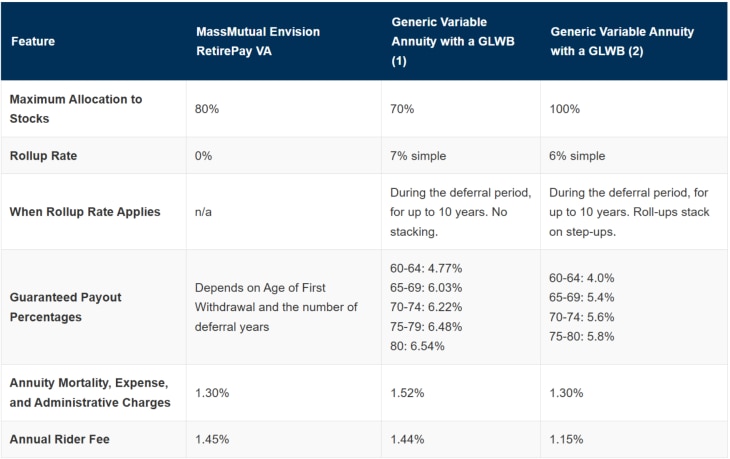
We consider MassMutual Envision with RetirePay and two hypothetical variable annuities, each with a GLWB. The first is MassMutual Envision variable annuity with the RetirePay optional living benefit. This GLWB allows for equity allocations of up to 80% (which we assume to be used). This GLWB does not offer a benefit base roll-up rate during the accumulation period, though step-up opportunities are provided on an annual basis in the same manner as all three GLWBs considered. Rather than emphasizing the benefit base roll-up rate, this GLWB takes a distinct approach to the age-based guaranteed withdrawal rate schedule — the roll-up takes place in the withdrawal rates. The withdrawal rate at the income start age depends on both age and the number of years of deferral before the guaranteed income distributions begin. This product is designed to provide increased income through higher rate bands at ages 62, 67, and 72 as shown in Exhibit 2.

Illustration of ages designed to reflect retirement inflection points understood by consumers

As such, efforts were made by the insurance carrier with increased withdrawal rates to support better outcomes for RetirePay at these ages.

Exhibit 2

 Chart showing Income Start Age and Years of Deferral 

This table works differently than other GLWBs. To find the withdrawal rate, one calculates the number of years of deferral between the issue age and the income start age and then uses that column as linked to the row for the income start age. For instance, someone who is issued the annuity at age 57 and defers to age 67 would obtain a withdrawal rate of 7.65%. If this person started income one year sooner at 66, the withdrawal rate with 9 years of deferral is 6.95%. If this 57-year-old waits until 72 to start income, the withdrawal rate is 8.15%, and so on.

The other characteristics for RetirePay are summarized in Exhibit 3. Other important details relate to its fees. These include 1.30% mortality and expense fees and 0.75% average subaccount fund fees applied to the contract value. The 1.45% GLWB benefit rider fee for the single life highest anniversary value step-up is multiplied by the benefit base and applied against the contract value. Annual data is used for simulations, with annual step-up opportunities.

Exhibit 3

Chart showing a summary of the variable annuities with a GLWB

The second variable annuity with a GLWB is modeled after the average characteristics of five leading variable annuities with GLWBs, based on sales. Its details include a maximum equities allocation of 70%, and a 6.75% simple roll-up rate, without stacking applied, which lasts for up to 10 years or until lifetime income starts. The withdrawal schedule depends on the age that income starts, and these details are provided in Exhibit 3. Fees include 1.97% all-in on the contract value and 1.34% on the benefit base to cover income protections.

The third variable annuity with GLWB is modeled after an existing option that is known for its investment freedom. It allows a 100% equity allocation. It also offers a 6% compounded roll-up rate for up to 10 years. Roll-ups do stack on top of any step-ups rather than applying only to the initial purchase payment. The age-based withdrawal rate schedule is based on the income start date. Fees are 2.05% on the contract value and 1.15% on the benefit base less any distributions taken.

Results

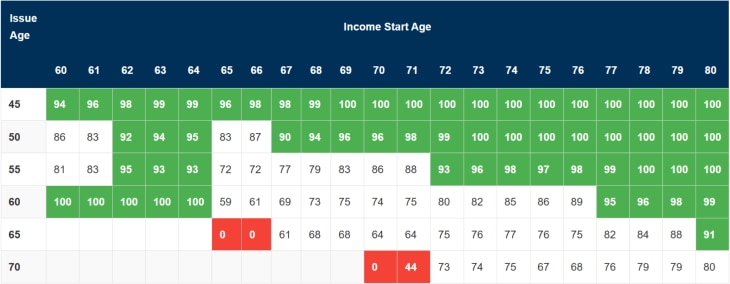
We begin the analysis by comparing the initial income offered by RetirePay and the first generic GLWB. This information is provided in Exhibit 4. For issue ages between 45 and 80, and for income start ages between 60 and 80, it shows the percentage of historical simulations in which the initial income is higher with RetirePay. For example, if the annuity was issued at age 45 and income started at age 70, RetirePay could offer a higher initial amount of guaranteed lifetime income in 100% of the historical simulations. The historical data includes 153 years of returns. This scenario includes a 25-year deferral period before income begins, allowing for 128 rolling historical outcomes. This same process is repeated for all age combinations, and we find that RetirePay is significantly more likely to offer greater income in most age scenarios. The only exceptions to this are relatively shorter deferral periods before starting income at age 65 or 66. Otherwise, RetirePay shows a high likelihood of providing more guaranteed income.

Exhibit 4

Probability that RetirePay offers More Initial Income than First Generic GLWB From Rolling Historical Periods, 1871–2023.

Chart showing annuity issue age and income start age

Note: Green shading for success rates at 90% or greater; red shading for success rates 50% and below. White shading for success rates between 51% and 89%.

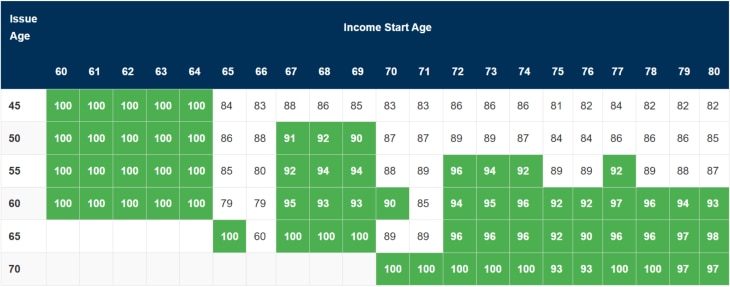
We find similar outcomes when comparing RetirePay to the second generic GLWB offering greater equity exposure, except that RetirePay does not provide more guaranteed income than the second generic VA with a GLWB. The generic GLWB benefits both from the higher equity allocation and from the ability to stack roll-ups on step-ups during the first 10 years of deferral. To get the full benefit of the generic GLWB, it would be necessary to take advantage of this higher equity allocation. But even for retirees comfortable with the risk, RetirePay is competitive through its step-ups and withdrawal rate schedule.

Exhibit 5

Probability that RetirePay offers More Initial Income than Second Generic GLWB From Rolling Historical Periods, 1871–2023.

Chart showing probability that RetirePay offers more Initial Income than second generic GLWB from rolling historical periods, 1871–2023 

Note: Green shading for success rates at 90% or greater; red shading for success rates 50% and below. White shading for success rates between 51% and 89%. It is the combination of roll-ups, step-ups, and withdrawal rates that combine to provide more guaranteed income.

To provide more meaning around the implications of the success rates shown in the previous exhibits, Exhibit 6 shows the average starting payments for the three different annuities with GLWBs structures across the historical simulations for 10-year deferral periods following three different starting ages. RetirePay is designed to be most competitive at these ages. With all three scenarios, the highest average guaranteed income amount is provided through the RetirePay structure. It even comes out ahead on average compared to the second generic GLWB despite that annuity using a 100% equity allocation. The driving force for this out-performance is the higher guaranteed withdrawal percentages, especially at longer deferrals.

Exhibit 6

Chart showing the average starting guaranteed payment for different starting ages and deferral periods, $100,000 Initial purchase payment from rolling historical periods, 1871–2023

To bring more life to these findings, we also provide visuals for the growth of the benefit base and contract value, as well as the initial retirement income generated for different historical periods. We consider an issue age of 57 and an income start age of 67. Halpern provides evidence that a 10-year deferral period is common for variable annuities with GLWBs,3 as this matches both the typical period that roll-ups are applied as well as the period that withdrawal rates increase with RetirePay. We consider three 10-year bear markets and three 10-year bull markets to compare RetirePay with both of the generic GLWBs. We use the highest stock allocation allowed with each annuity, which is 80% for RetirePay, 70% for the first generic variable annuity, and 100% for the second generic variable annuity.

First, Exhibits 7–9 document the bear market performance from 1974 to 1984. Despite several market downturns, the contract value for these annuities grew somewhat consistently to provide similar benefit bases after 10 years, with the second generic GLWB being the largest. But as will be a consistent theme, the higher withdrawal rate on RetirePay (7.65% compared to 5.31% and 5.15%) allows it to come out ahead with providing the most income. RetirePay provides $13,853 of guaranteed income, compared to $9,386 and $10,030 for the other GLWBs. Exhibits 7–24 are hypothetical examples based on previous market returns. Past performance is not indicative of future returns. These are for illustrative purposes.

The key to this result is the annual step-ups outpaced the benefit base roll-up; therefore, the ending benefit base values after 10 years were similar. However, the RetirePay guaranteed withdrawal rates were higher, resulting in a larger guaranteed annual income for the contract holder.

Exhibit 7

Line chart showing the bear market: comparing RetirePay and generic GLWB #1 Issue Age: 57; Income Start Age 67, Market Data: 1974–1984

Exhibit 8

Line chart showing the bear market: comparing RetirePay and generic GLWB #2 Issue Age: 57; Income Start Age 67, Market Data: 1974–1984

Exhibit 9

A bear market: comparing RetirePay and generic variable annuities with GLWBs issue age: 57; income start age 67, market data: 1974–1984

Next, Exhibits 10–12 showcase the bear market from 1999 to 2009. In this case, contract values grow in 1999 to raise the benefit base, but then fall behind the benefit base consistently for the annuities during the rest of the accumulation period. The generic GLWBs do benefit from the roll-up rate for the benefit base in a manner that does help them to provide more guaranteed income. RetirePay provides $8,174 in guaranteed income, compared to $8,894 and $9,742 with the generic GLWBs.

Exhibit 10

Line chart showing the bear market: comparing RetirePay and generic GLWB #1 issue age: 57; income start age 67, market data: 1999–2009

Exhibit 11

Line chart showing bear market: comparing RetirePay and generic GLWB #2 issue age: 57; income start age 67, market data: 1999–2009

Exhibit 12

Chart showing the bear market: comparing RetirePay and generic variable annuities with GLWBs issue age: 57; income start age 67, market data: 1999–2009

The third bear market scenario shown in Exhibits 13–15 reflects the years 2007 to 2017. The roll-up rates grow the benefit bases for the generic GLWBs ahead in the early years, but later in the accumulation period RetirePay does earn some step-ups. With the higher withdrawal rate of 7.65%, this allows RetirePay to offer $10,587 in guaranteed income, compared to $8,894 and $9,223 from the generic GLWBs.

Exhibit 13

Line chart showing the bear market: comparing RetirePay and generic GLWB #1 issue age: 57; income start age 67, market data: 2007–2017 

Exhibit 14

Line chart showing the bear market: comparing RetirePay and generic GLWB #2 issue age: 57; income start age 67, market data: 2007–2017

Exhibit 15

Chart showing the bear market: comparing RetirePay and generic variable annuities with GLWBs issue age: 57; income start age 67, market data: 2007–2017

Next, we shift to bull market periods. First, Exhibits 16–18 provide outcomes for 1982 to 1992. In this case, roll-ups were inconsequential, as the contract value growth provides consistent step-ups for the GLWBs. By 1992, RetirePay offers $26,235 of guaranteed income, compared to $18,038 and $19,098 from the generic GLWBs.

Exhibit 16

Line chart showing the bull market: comparing RetirePay and generic GLWB #1 issue age: 57; income start age 67, market data: 1982–1992

Exhibit 17

Line chart showing the bull market: comparing RetirePay and generic GLWB #2 issue age: 57; income start age 67, market data: 1982–1992

Exhibit 18

Chart showing the bull market: comparing RetirePay and generic variable annuities with GLWBs issue age: 57; income start age 67, market data: 1982–1992

Next, Exhibits 19–21 use the bull market from 1990 to 2000. Again, step-ups dominate in bull markets, and both GLWBs again see consistent growth to their benefit base. With the higher withdrawal rate, RetirePay again offers more income after 10 years, with $24,148 from RetirePay, compared to $15,590 and $19,853 for the generic GLWBs. As a reminder, all exhibits are hypothetical examples based on previous market returns. Past performance is not indicative of future returns. These are for illustrative purposes.

Exhibit 19

Line chart showing the bull market: comparing RetirePay and generic GLWB #1 issue age: 57; income start age 67, market data: 1990–2000

Exhibit 20

Line chart showing the bull market: comparing RetirePay and generic GLWB #2 issue age: 57; incomes start age 67, market data: 1990–2000

Exhibit 21

Chart showing the bull market: comparing RetirePay and generic variable annuities with GLWBs issue age: 57; income start age 67, market data: 1990–2000

Finally, Exhibits 22–24 provide the situation for 2009 to 2019. The results are similar, as consistent step-ups keep the benefit bases growing, and RetirePay again offers more guaranteed income ($17,635 instead of $11,195 or $15,780).

Exhibit 22

Line chart showing the bull market: comparing RetirePay and generic GLWB #1 issue age: 57; income start age 67, market step-ups. data: 2009–2019

Exhibit 23

Line chart showing the bull market: comparing RetirePay and generic GLWB #2 issue age: 57; income start age 67, market data: 2009–2019

Exhibit 24

Chart showing the bull market: comparing RetirePay and generic variable annuities with GLWBs, issue age: 57; income start age 67, market data: 2009–2019

Conclusion

This white paper compares three variable annuities with guaranteed lifetime withdrawal benefits: It analyzes the hypothetical historical performance of MassMutual EnvisionSM with RetirePay variable annuity, a GLWB that offers higher withdrawal rates for longer deferrals, and two generic variable annuities with GLWBs that have different features such as benefit base roll-ups, withdrawal rates, and equity allocations. Financial market data was used from 1871 to 2023 to simulate different scenarios and uses annual data for large-cap U.S. equities, 10-year Treasury bonds, and inflation to compare the outcomes of MassMutual Envision with RetirePay and two generic variable annuities with GLWBs for various issue ages and income start ages. This paper considers both bull and bear markets.

The importance of retirement income planning today for Americans is greater than any time in history — the risks to retirement continue as people are living longer, healthcare costs continue to rise, and the market remains unpredictable. The need for a guaranteed income is greater than ever. Variable Annuities with GLWBs are one way to help mitigate those risks. This paper suggests that RetirePay and traditional GLWBs fit different client needs and scenarios. RetirePay and traditional GLWBs have different approaches to providing guaranteed income. Traditional GLWBs offer benefit base guaranteed growth using roll-ups, which may appeal to clients who value certainty or plan with a guaranteed growth model. RetirePay focuses on the withdrawal rate growth, which offers the potential for higher lifetime income in longer deferral periods or in periods with strong market performance.

This paper finds that RetirePay provides the most guaranteed annual lifetime income in many scenarios. RetirePay’s higher withdrawal rate, which increases with the length of deferral, gives it an advantage over the other GLWBs in terms of providing more guaranteed income for the contract holder. RetirePay outperforms the other GLWBs in many scenarios, such as when the contract holder seeks a longer deferral period, or when the market performance is strong.

Let's work together

Call us today to talk about how you can add dependability to your clients’ retirement strategies.

  1-855-464-3436 Or, learn more about variable annuities from MassMutual.

Not a financial professional?
Visit MassMutual.com.

FOR BROKER/DEALER USE. NOT FOR USE WITH OTHER AUDIENCES.

https://www.limra.com/en/newsroom/industry-trends/2023/are-in-plan-annuities-at-a-tipping-point/

2 Milevsky, Moshe A., and V. Kyrychenko. 2008. “Portfolio Choice with Puts: Evidence from Variable Annuities.” Financial Analysts Journal, Vol. 64, No. 3 (May/June), p. 80–95.

3 Halpern, Eric. 2021. “Ruark Consulting Releases 2021 Variable Annuity Studies.” (June 25). Available at: ruark.co/ruark-consulting-releases-2021-variable-annuity-studies/

The information provided in this white paper is not written or intended as specific tax or legal advice. MassMutual and its subsidiaries, employees, and representatives are not authorized to give tax or legal advice. Individuals are encouraged to seek advice from their own tax or legal counsel.

This white paper is designed to provide information. It does not represent advice or a recommendation regarding a particular insurance product or to engage in or refrain from a particular course of action. The information within has not been tailored for any individual.

MassMutual is not affiliated with Wade Pfau and the American College of Financial Services.

MassMutual has engaged WealthVest to provide wholesaling services. WealthVest is not a subsidiary of MassMutual and wholesalers are not MassMutual employees.

MassMutual Envision (Contract Form FPVDA21 and ICC21-FPVDA in certain states, including North Carolina) is a flexible premium deferred variable annuity contract issued by Massachusetts Mutual Life Insurance Company, Springfield, MA 01111-0001.

The material is intended to compare MassMutual RetirePay to competitor GLWBs as of the date noted during the markets referenced (1982–1992, 1990–2000, 2009–2019). You should run an illustration to verify income amounts.

Variable annuities offered through registered representatives of MML Investors Services, LLC, Springfield, MA 01111-0001, or a broker-dealer that has a selling agreement with MML Strategic Distributors, LLC, Springfield, MA 01111-0001.

Principal Underwriters: MML Investors Services, LLC (MMLIS), Member SIPC, and MML Strategic Distributors (MSD). MMLIS and MSD are members of FINRA and subsidiaries of Massachusetts Mutual Life Insurance Company, Springfield, MA 01111-0001.

Any guarantees explicitly referenced herein are based on the claims-paying ability of the issuing insurance company. MassMutual Envision with RetirePay and/or certain features and investment options may not be available in all states or firms.

©2024 WealthVest Marketing, Inc. All rights reserved.